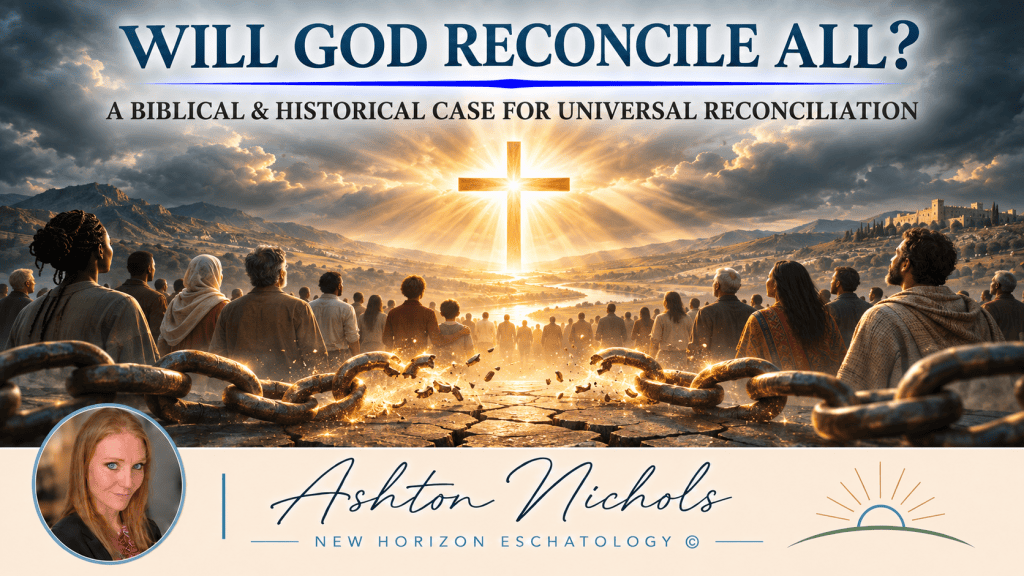
For many, this is a forbidden—even heretical—topic. When it is mentioned, the “turn or burn” crowd often finds their heads spinning. But let’s face it: I am known for tackling controversial subjects, especially when I see compelling evidence for a view. As per usual, a trigger warning is necessary here, as I anticipate significant resistance from the “eternal conscious torment” (ECT) camp.
Honestly, I am not surprised so many have a hard time accepting this view; it goes against our basic human nature. Let’s be completely honest for a moment: when we witness monstrous acts of evil—such as murder or sexual assault—we instinctively crave vengeance. We want those we view as monsters to suffer for the evil they have committed. Many of us, while scrolling through social media and seeing news of a mass school shooting, have looked at the perpetrator and thought, “There is a special place reserved in hell for you!” I believe this is a normal human response.
However, to accept universal reconciliation, you must surrender that desire for revenge. You must accept the possibility that God may have plans for such people that do not include eternal conscious torment or even annihilation. God sees a larger picture that we cannot—a lesson we need to learn in general, regardless of whether we embrace universal reconciliation. We must keep in mind:
“For my thoughts are not your thoughts, neither are your ways my ways,” declares the Lord. “As the heavens are higher than the earth, so are my ways higher than your ways and my thoughts than your thoughts.” (Isaiah 55:8–9)
And as 1 Corinthians 2:16 says:
“For, ‘Who has known the mind of the Lord so as to instruct him?’ But we have the mind of Christ.”
Scriptures Supporting Universal Reconciliation
In my time studying the Bible alongside this topic, I have found a vast number of verses that support the view that all will be reconciled back to God. Here is a brief list of scriptures supporting this position:
Isaiah 45:23: “By myself I have sworn, my mouth has spoken in righteousness, and my word will not be revoked: Every knee will bow to me, every tongue will swear oaths to the Lord.”
1 Chronicles 16:34: “Give thanks to the Lord, for he is good; his love endures forever.”
Romans 5:18–19: “Consequently, just as one trespass resulted in condemnation for all people, so one righteous act resulted in justification and life for all people.”
1 Corinthians 15:22: “For as in Adam all die, so in Christ all will be made alive.”
Colossians 1:19–20: “For God was pleased to have all his fullness dwell in him, and through him to reconcile to himself all things, whether on earth or in heaven, making peace through his blood, shed on the cross.”
Colossians 3:11: “Here there is no Greek or Jew, circumcised or uncircumcised, barbarian, Scythian, slave or free, but Christ is all and is in all.”
1 Timothy 2:3–4: “This is good, and pleasing in the sight of God our Savior, who wants all people to be saved and to come to a knowledge of the truth.”
1 Timothy 2:6: “…who gave himself as a ransom for all…”
1 Timothy 4:10: “For to this end we labor and strive, that we have our hope set on the living God, who is the Savior of all people, especially of those who believe.”
2 Peter 2:1: “…even as false prophets also arose among the people, just as there will be false teachers among you, who will secretly bring in destructive heresies, even denying the Master who bought them—bringing upon themselves swift destruction.”
Notice that this verse says He bought them too! I believe, given the context and audience relevance, that this “destruction” refers to physical death.
While there are many more supporting scriptures, I particularly want to draw attention to Acts 3:21:
“Heaven must receive him until the time comes for God to restore everything, as he promised long ago through his holy prophets.”
The Greek word used here is apokatastasis. It means “restoration,” “restitution,” or “re-establishment,” referring to the return of something to its former or original condition—often implying a renewed and even better state.
Remember Romans 5:18–19 and 1 Corinthians 15:22: “For as in Adam all die, so in Christ all will be made alive.” We must ask ourselves: Was Jesus’ sacrifice more powerful than Adam’s sin, or not? Was Jesus’ sacrifice only sufficient to save some, or all? These are questions you should meditate on and pray about.
A Historical Perspective
This view may be new to you, and I am sure many have never heard of universal reconciliation. However, believe it or not, this view is not new at all. In fact, it was the popular view of the early church for the first 500 years of history! Universal reconciliation was once the most widely held belief.
Of the six major theological schools at that time, four taught universal reconciliation: Alexandria, Antioch, Caesarea, and Edessa/Nisibis. The remaining two taught annihilation (Ephesus) and eternal conscious torment (North Africa/Carthage).
Let’s look briefly at the early leaders of this movement:
– Clement of Alexandria (c. 150–215): One of the first to articulate that God’s punishments are remedial—intended for salvation rather than mere retribution.
– Origen of Alexandria (c. 184–253): The most famous proponent of apokatastasis. He argued that even the most fallen beings would eventually be reconciled to God through a process of purification.
– Gregory of Nyssa (c. 335–395): A central figure in the development of the Trinity and a highly respected Saint. He explicitly taught that evil would eventually vanish and all humanity would be restored to God.
– Theodore of Mopsuestia (c. 350–428): A leader in the school of Antioch who held that the resurrection would eventually bring all rational beings into a state of sinlessness.
The fact that four out of six schools embraced this view is quite telling, and I personally believe they were right. God is restorative, not punitive. It amazes me that only one school taught ECT—the view that the vast majority hold today.
The Shift to Eternal Conscious Torment
The question then becomes: Who is responsible for the now-popular doctrine of ECT? Why did it become the standard while the majority view of the early Christians was labeled heretical and buried?
The person largely responsible is St. Augustine. While he was not the first to hold the view—he had predecessors like Tertullian—Augustine solidified it and made it the official orthodoxy of the Western church. However, when we examine Augustine’s history, it becomes clear that his theology should be questioned.
Augustine was not fluent in Greek, a fact that had a massive impact on Western Christianity. While he was a master of Latin, his struggle with Greek is one of the great “what ifs” of history.
A Childhood Hatred of Greek: In Confessions, Augustine admits he hated studying Greek because his teacher was a brutal man who beat him for mistakes.
Limited Skill: As an adult, he realized this gap was a problem, but he never became comfortable reading Greek for deep philosophical study. He relied on Latin translations rather than the original Greek New Testament, meaning he could not engage deeply with the universalist views of the Eastern Church Fathers.
The “Translation Error”: His lack of Greek led to a “catastrophic” error in Romans 5:12, which became the bedrock of his doctrine of Original Sin. Because he read the Latin “in whom,” he concluded the entire human race was literally present in Adam and inherited his guilt. The Greek fathers understood this verse to mean we inherit Adam’s mortality, which then causes us to sin—a much less legalistic view.
Impact on Universalism: Augustine dismissed the Greek Fathers’ views as a “tender-hearted” error. He famously claimed the Greek word aionios (used for “eternal”) meant “without end,” whereas Greek-speaking theologians understood it to mean “pertaining to an age.”
In my opinion, his struggle to study the scriptures in their original Greek makes his theology unreliable on this point.
The Political Agenda
It is also evident there was an agenda behind ECT. As I have said many times, religion is often the puppet master of politics. As Christianity became the state religion of Rome, leaders felt that the threat of eternal punishment was a more effective tool for maintaining social order than the hope of restoration. Fear is a proven weapon to control the masses and keep the “sheeple” in line.
So, they buried the truth. God’s plan of restoration for all was turned into restoration for a select few. They did the same thing with the doctrines of dispensationalism and Zionism, which masked Jesus’ finished work and fulfillment of all scripture, making it all “future” to support their political agendas. It shouldn’t come as a surprise that they would bury the most beautiful act of love in the world: Jesus’ once-for-all sacrifice.
One thing I have learned in my journey is not to take anyone’s word for anything, but to do as instructed in 1 Thessalonians 5:21: “Test everything; hold fast what is good.” I encourage you all to do the same.
I hope this article challenges you to ask tough questions and seek wisdom through prayer. Is God’s plan of reconciliation for a select few, or is His love truly ultimate?
Support the Work
If you found this article valuable and would like to support my writing, your generosity is deeply appreciated.


Leave a Reply