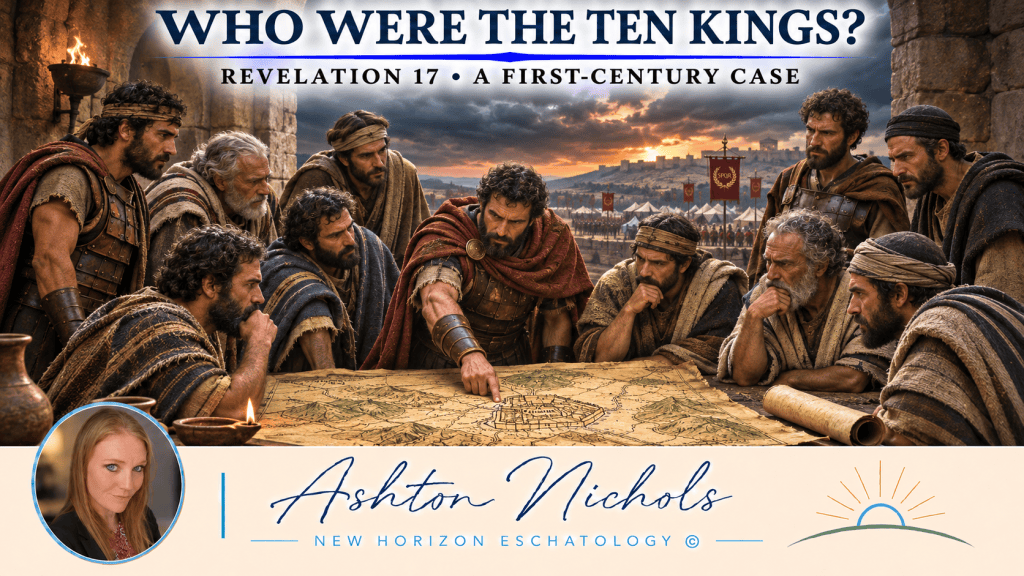
Obviously, this is a widely debated topic in eschatology, so the surrounding theories are many. To keep this article as brief as possible, we will only brush the surface of the most popular theories regarding the ten kings that futurists believe and teach today.
The majority of futurists believe these prophecies describe a literal, global political realignment that will occur just before or during the Great Tribulation. I agree that these ten kings spoken of in Revelation 17:12 were ten individual, literal religious and political figures. However, I do not agree that this is (or was) “global” in the way we define the term today. I also know from Scripture that Paul, Silvanus, Timothy, and John all stated they were undergoing the tribulation—see 1 Thessalonians 3:4 and Revelation 1:9—which Jesus prophesied would come upon their generation in Matthew 23 and 24.
So, we can already see that these theories are built upon sand rather than the rock-solid foundation of Scripture. Nonetheless, let’s briefly examine them:
Popular Futurist Theories
The Revived Roman Empire (The European Union)
This is the most popular view in modern dispensationalism.
The Theory: The ten kings represent a ten-nation confederacy arising from the territory of the ancient Roman Empire.
The “Evidence”: Futurists point to the European Union as the “embryo” of this system. When the EEC (European Economic Community) reached exactly ten members in 1981, prophecy circles were highly active.
The 2026 Context: Since the EU now has 27 members, some theorists have shifted, suggesting the ten kings aren’t ten nations, but ten inner-circle leaders or ten regions within a reorganized European superstate.
The Club of Rome / 10 Global Regions
A more globalist interpretation looks beyond Europe to a worldwide administrative system.
The Theory: In 1974, the Club of Rome (a global think tank) published a report dividing the world into ten political/economic regions.
The Breakdown: These regions (e.g., North America, Western Europe, Japan, Latin America, etc.) are seen by some as the literal “ten kingdoms” that will eventually hand their authority over to a single world leader (the Beast).
Corporate Oligarchs (The “Alternative” View)
A newer theory emerging in the 2020s suggests the “kings” might not be political heads of state at all.
The Theory: They are titans of industry and technology—essentially “tech kings” or global oligarchs.
The Reasoning: The Greek word for king (basileus) can refer to anyone in a position of supreme authority. In an era where billionaires and CEOs of AI/Social Media companies hold more power than many small nations, some suggest these ten individuals will provide the technological “power and strength” the Beast needs to control the global economy.
The Islamic Confederacy
Popularized by authors like Joel Richardson, this view shifts the focus from Europe to the Middle East.
The Theory: The “Revived Roman Empire” is actually a Revived Ottoman Empire or an Islamic Caliphate.
The Identification: The ten kings are seen as a coalition of ten Muslim nations that unite to destroy “the Harlot” and wage war against Israel.
For the sake of time, I will not go down all of these rabbit holes to individually debunk them. Instead, I will simply summarize: none of these theories hold up to the test of Sola Scriptura, history, or audience relevance—which is clearly stated at the very beginning of Revelation.
The Historical Reality
Now that we have taken a brief stroll through the popular theories, let’s look at who I believe—through prayer and extensive study—these ten individual kings really were and what the “one hour” actually represented.
Revelation 17:12: “The ten horns you saw are ten kings who have not yet received a kingdom, but who for one hour will receive authority as kings along with the beast.”
To figure out who these individual kings are, we must have a firm understanding of audience relevance and the time statements found throughout Revelation. John was banished to the island of Patmos for preaching Jesus (Revelation 1:9), and he stated these things were to take place soon (Revelation 1:1–3; 22:10). With this in mind, we must look to history; we in the year 2026 are not the primary audience John was writing to.
The main historian who wrote extensively regarding the Jewish-Roman War is Flavius Josephus. While I also lean on Suetonius, Tacitus, and Dio Cassius, Josephus is vital because he was actually one of the ten kings given authority for “one hour.”
The Road to War: AD 66–67
In the spring of AD 66, Cestius Gallus, the governor of Syria, visited Jerusalem during Passover and reported to Nero on the city’s status. It is recorded that 256,500 sacrifices were made, with an estimated 2.7 million people present. Notably, the Jews were making twice-daily sacrifices for Caesar and the Roman people.
This ended in the summer of AD 66 (aligning with Daniel 12:11) when Jewish zealots forcefully took control of the Temple. This act, according to Josephus, ignited the war in August AD 66. Eleazar, son of Ananias the High Priest, persuaded the ministers to reject any gift or sacrifice from a foreigner—specifically “the sacrifice of Caesar” (Wars 2.17.2). They also massacred the Roman garrison at the Antonia Fortress. (Quick fact: The “Western Wall” is actually a remnant of this fortress, not the Second Temple.)
In November AD 66, Cestius Gallus arrived with the 12th Legion to suppress the uprising. After surrounding Jerusalem, he suddenly and inexplicably ordered a retreat. This gave Christians the window to escape (see my article “The Great Escape”). The Jewish rebels pursued the retreating Romans, slaughtering approximately 5,700 soldiers. This victory gave the Jews a false sense of “peace and safety,” just before the “dreadful day of the Lord” came upon them (1 Thessalonians 5:3).
The Ten Kings Identified
Knowing Roman retaliation was inevitable, Jewish leaders gathered in the Temple to appoint generals for the war Nero officially declared in February AD 67. According to Josephus (Wars 2.20.3–4), there were exactly ten generals appointed:
1. Joseph, son of Gorion (Governor of Jerusalem)
2. Ananus the High Priest (Governor of Jerusalem)
3. Jesus, son of Sapphias (Idumaea)
4. Eleazar, son of Ananias (Idumaea)
5. Niger, the then-governor of Idumaea (Idumaea)
6. Joseph, son of Simon (Jericho)
7. Manasseh (Perea)
8. John the Essene (Thamna, Lydda, Joppa, and Emmaus)
9. John, son of Matthias (Gophnitica and Acrabattene)
10. Flavius Josephus, son of Matthias (The Galilees and Gamala)
These ten kings received their “kingdoms” (territories) in early AD 67. The phrase “one hour” is used throughout Revelation to describe the judgment of the “Great City” (Jerusalem—where our Lord was crucified, Revelation 11:8).
Daniel and Revelation both provide the duration of this judgment: 42 months, or 3.5 years. Josephus reports that these kings held authority during this exact span: from Nero’s declaration of war in February AD 67 to the destruction of the Temple in August AD 70.
We can conclude that the ten kings of Revelation were literal Jewish generals, and the “one hour” was a scriptural metaphor for the 3.5-year period of judgment that ended the Old Covenant era.
Conclusion: A Foundation of History
By anchoring our understanding of Revelation in the first century, the text moves from a source of modern anxiety to a powerful testimony of God’s sovereignty. These ten kings weren’t globalists or tech moguls of the future; they were specific men at a specific time, fulfilling a specific prophecy that Jesus gave to His generation.
When we view the Bible through the lens of history and context, we find that God is not a God of confusion. He did exactly what He said He would do, exactly when He said He would do it. This realization allows us to rest in the “rock-solid foundation” of Scripture rather than the shifting sands of modern speculation.
Join the Conversation
If this study has challenged or encouraged you, I invite you to share it with someone who is currently wrestling with the complexities of Revelation. Understanding the past is the key to having a clear vision for the future.
I hope this article is a blessing to you and sheds light on a highly misunderstood book of the Bible: Revelation.
Support the Work
If this article has been valuable to you and you would like to support my ongoing writing and study, you can do so here:


Leave a Reply