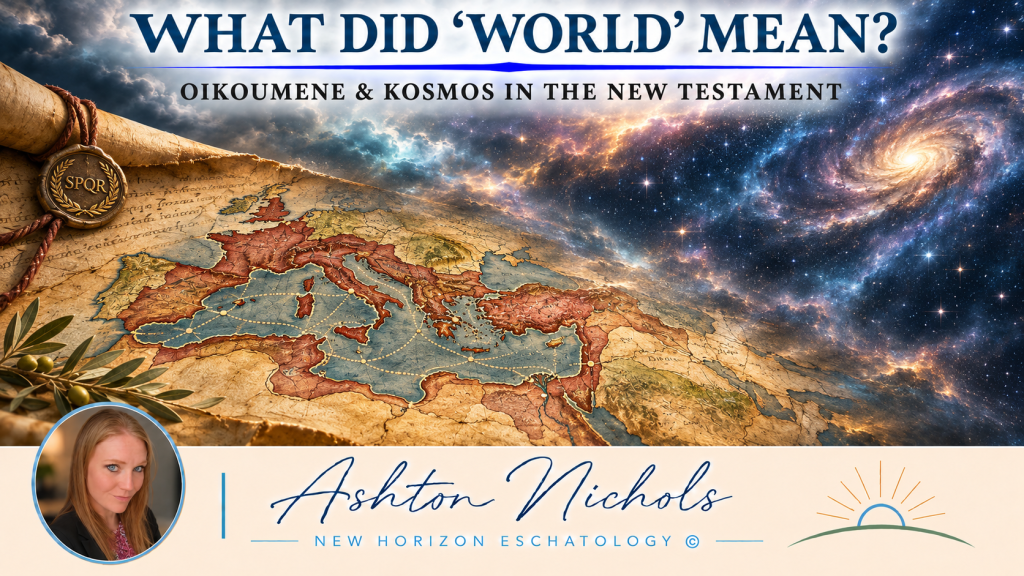
Oikoumene: The Inhabited World
Let’s begin with oikoumene, which has often been translated as “world” in our Bibles. Oikoumene does not signify the entire globe as we understand it today; rather, it refers to the inhabited world or, more specifically, the Roman Empire—the known world of that time. This term appears 15 times in the New Testament:
– Matthew 24:14: “And this gospel of the kingdom will be proclaimed throughout the whole world (oikoumene – the inhabited world) as a testimony to all nations, and then the end will come.”
– Luke 2:1: “In those days a decree went out from Caesar Augustus that all the world (oikoumene – the inhabited world) should be registered.”
– Luke 4:5: “And the devil, taking him up to a high mountain, showed him all the kingdoms of the world (oikoumene – the inhabited world) in a moment of time.”
– Luke 21:26: “Men fainting with fear and with foreboding of what is coming on the world (oikoumene – the inhabited world), for the powers of the heavens will be shaken.”
– Acts 11:28: “And one of them named Agabus stood up and foretold by the Spirit that there would be a great famine over all the world (oikoumene – the inhabited world; the NIV says ‘Roman world’ here), which took place in the days of Claudius.”
– Acts 17:6: “And when they could not find them, they dragged Jason and some of the brothers before the city authorities, shouting, ‘These men who have turned the world (oikoumene – the inhabited world) upside down have come here also.’”
– Acts 17:31: “Because he has fixed a day on which he will judge the world (oikoumene – the inhabited world) in righteousness by a man whom he has appointed; and of this he has given assurance to all by raising him from the dead.”
– Acts 19:27: “And there is danger not only that this trade of ours may come into disrepute but also that the temple of the great goddess Artemis may be regarded as nothing and that she who is worshiped throughout the whole world (oikoumene – the inhabited world) may even be deposed from her magnificent [position].”
– Acts 24:5: “For we have found this man a pestilent fellow, an agitator among all the Jews throughout the world (oikoumene – the inhabited world), and a ringleader of the sect of the Nazarenes.”
– Romans 10:18: “But I ask, have they not heard? Indeed they have, for ‘Their voice has gone out to all the earth, and their words to the ends of the world’ (oikoumene – the inhabited world).”
– Hebrews 1:6: “And again, when he brings the firstborn into the world (oikoumene – the inhabited world), he says, ‘Let all God’s angels worship him.’”
– Hebrews 2:5: “For it was not to angels that God subjected the world (oikoumene – the inhabited world) to come, of which we are speaking.”
– Revelation 3:10: “Because you have kept my word about patient endurance, I will keep you from the hour of trial that is coming on the whole world (oikoumene – the inhabited world), to try those who dwell on the earth.”
– Revelation 12:9: “And the great dragon was thrown down, that ancient serpent, who is called the devil and Satan, the deceiver of the whole world (oikoumene – the inhabited world)—he was thrown down to the earth, and his angels were thrown down with him.”
– Revelation 16:14: “For they are demonic spirits, performing signs, who go abroad to the kings of the whole world (oikoumene – the inhabited world), to assemble them for battle on the great day of God the Almighty.”
Kosmos: More Than One Meaning
Our next Greek word translated as “world” in our Bibles is kosmos. Kosmos carries multiple meanings, including the physical universe, the inhabitants of the earth, and earthly systems and values that are opposed to God. It appears 187 times in the New Testament. Therefore, understanding the specific context is crucial when interpreting the meaning of kosmos in any given passage.
Here are some examples:
– The created universe or Earth: Kosmos can refer to the entire physical world, including the planet Earth. For example, Acts 17:24 speaks of God “who made the world and everything in it.”
– Humanity: Kosmos can also refer to the collective body of people. John 3:16 is a classic example: “For God so loved the world [kosmos] that he gave his one and only Son.” In this context, it signifies humanity as a whole.
– An evil system or force: Kosmos can also represent a system of values and practices that are opposed to God. Ephesians 2:2–3 describes the “world” (kosmos) along with the “flesh” and the “devil” as enemies of believers. John 12:31 refers to Satan as the “ruler of this world.”
– Adornment: In 1 Peter 3:3, kosmos is used in the older sense of adornment, specifically referring to outward embellishment.
Reading Scripture in Its First-Century Context
When reading Scripture, it’s important to try to view it through the lens of first-century people. Furthermore, delving into the ancient Greek language is vital because Greek often contains more nuanced meanings than a single English word can convey. In the New Testament, you need to put yourself in their shoes and ask how they would have understood and interpreted the words of Jesus and the apostles during that time.
I’ve had many individuals in my last article (“A Letter to My Fellow Brothers and Sisters in Christ”) argue that Matthew 24:14 has not been fulfilled because Scripture says the gospel will be preached throughout the “whole world.” As seen above, this passage is not referring to our current global understanding. It meant the inhabited world, the Roman world, the known world of that era. And it was fulfilled!
The Apostle Paul was very clear about the gospel being preached to the entire known world. And what was to come right after this? The end! 1 Corinthians 7:31 states, “For this world in its present form is passing away.” The word for “world” here is kosmos, but it’s not referring to the literal Earth. Its meaning encompasses the Judaic legal system, the religious system, and the Temple. The Apostle Paul tells us its present form was already passing away then. This was the end that was to come, and it did.
The Old Order Has Passed Away
Consider Revelation 21:3–4:
“And I heard a loud voice from the throne saying, ‘Look! God’s dwelling place is now among the people, and he will dwell with them. They will be his people, and God himself will be with them and be their God. He will wipe every tear from their eyes. There will be no more death’ or mourning or crying or pain, for the old order of things has passed away.”
Most people believe this means no more evil, literal crying, physical death, and pain. However, that’s not its true meaning. God no longer dwells in buildings made with hands (Acts 17:24). We are the temple (1 Corinthians 6:19). He dwells with us now! The old order of things passed away!
Remember Jesus and the Samaritan woman? What did he tell her?
John 4:21–24:
“Woman,” Jesus replied, “believe me, a time is coming when you will worship the Father neither on this mountain nor in Jerusalem. You Samaritans worship what you do not know; we worship what we do know, for salvation is from the Jews. Yet a time is coming and has now come when the true worshipers will worship the Father in the Spirit and in truth, for they are the kind of worshipers the Father seeks. God is spirit, and his worshipers must worship in the Spirit and in truth.”
Christ defeated death, the Temple and its system were destroyed, and there is no more separation from God. You don’t need to run to a temple and make animal sacrifices for sin or to worship and pray to God. The old order has passed away!
I hope what I’ve written will be a blessing to you and help shed light on these common misconceptions in Scripture.
Support the Work
If this article has been valuable to you, please consider supporting my writing so I can continue creating resources like this.


Leave a Reply