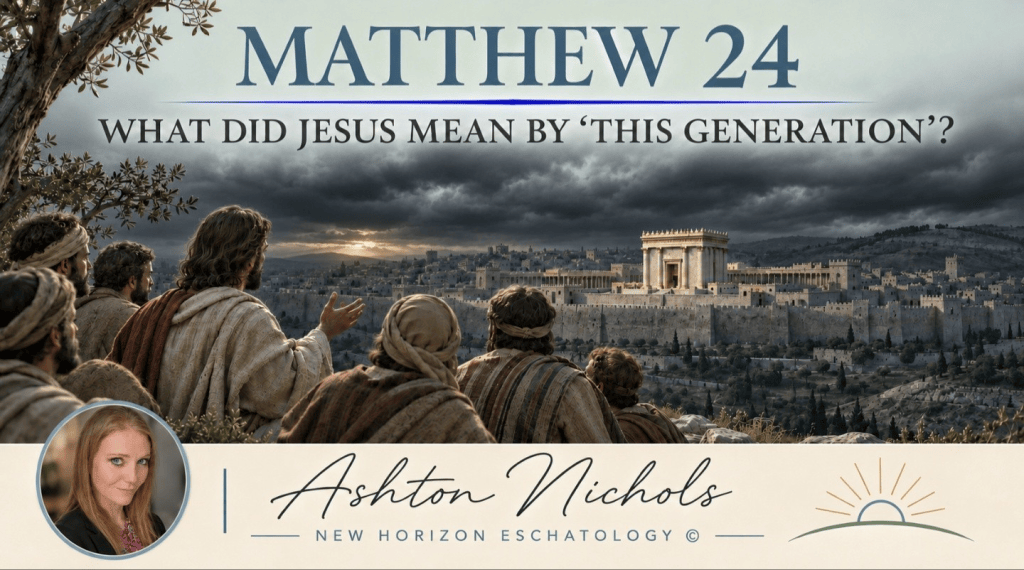
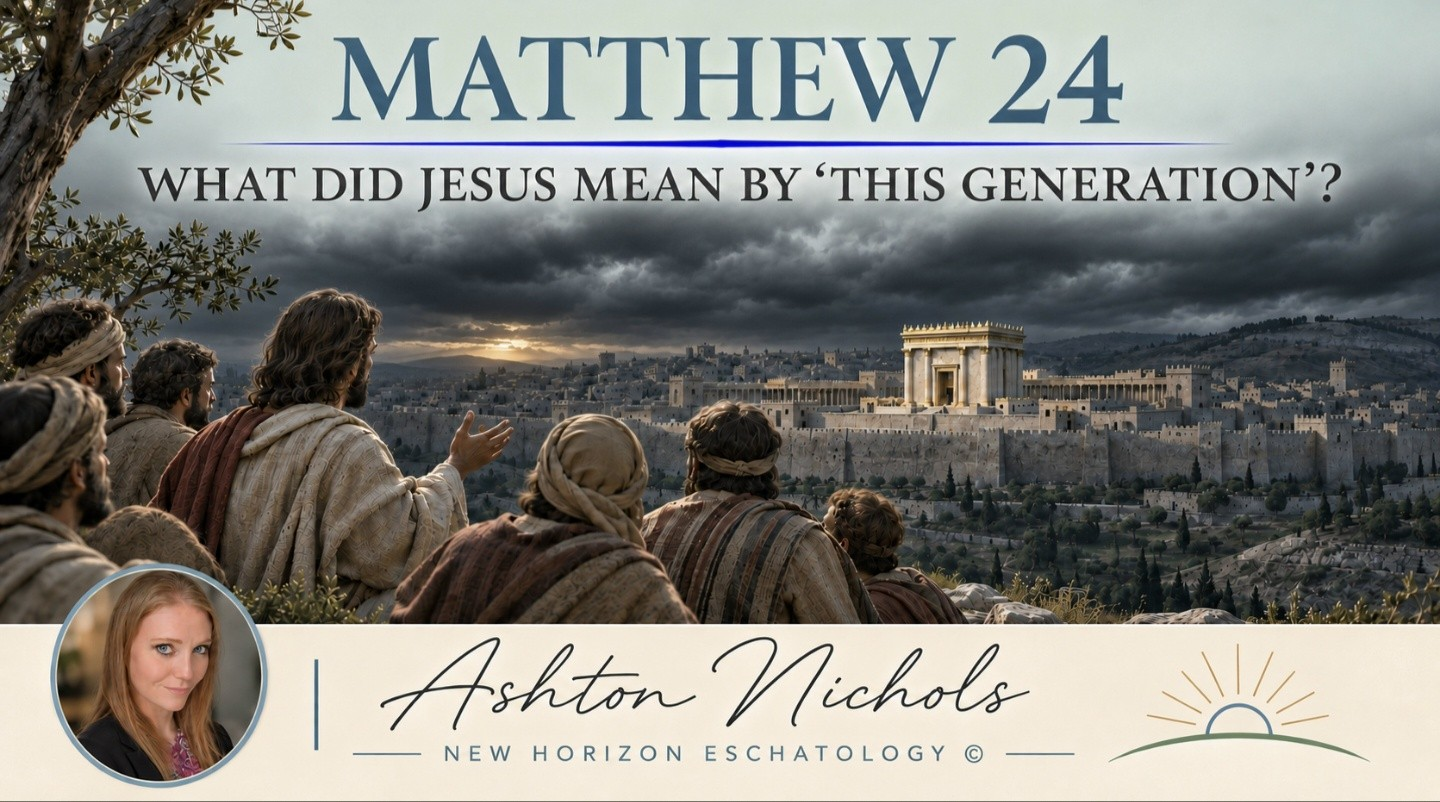
To understand Jesus’ words in Matthew 24, it helps to examine the context: Who was He speaking to? What was He addressing? Which generation did He say would witness these events? Let’s work through the chapter and consider those questions.
The Setting: Questions from the Disciples
Matthew 24 begins immediately after Jesus speaks about the temple:
Matthew 24:1–3 (NIV)
Jesus left the temple and was walking away when his disciples came up to him to call his attention to its buildings.
“Do you see all these things?” he asked. “Truly I tell you, not one stone here will be left on another; every one will be thrown down.”
As Jesus was sitting on the Mount of Olives, the disciples came to him privately. “Tell us,” they said, “when will this happen, and what will be the sign of your coming and of the end of the age?”
Jesus’ prophecy about the temple’s destruction prompted His disciples to ask direct questions. They were present with Him and would have understood His answers in light of what He had just said about the temple.
The disciples asked:
– “When will this happen?”—referring to the temple’s destruction.
– “What will be the sign of your coming?”
– “What will be the sign … of the end of the age?”
Jesus’ Answer to His Disciples
Jesus began by warning them about deception, wars, famines, earthquakes, persecution, and false prophets. He also said the gospel would be preached throughout the world before the end came:
“Watch out that no one deceives you. For many will come in my name, claiming, ‘I am the Messiah,’ and will deceive many. You will hear of wars and rumors of wars, but see to it that you are not alarmed. Such things must happen, but the end is still to come. Nation will rise against nation, and kingdom against kingdom. There will be famines and earthquakes in various places. All these are the beginning of birth pains.
“Then you will be handed over to be persecuted and put to death, and you will be hated by all nations because of me. At that time many will turn away from the faith and will betray and hate each other, and many false prophets will appear and deceive many people. Because of the increase of wickedness, the love of most will grow cold, but the one who stands firm to the end will be saved. And this gospel of the kingdom will be preached in the whole world as a testimony to all nations, and then the end will come.”
Fulfillment in the Apostles’ Time
The gospel preached to the known world: The phrase “the whole world” can be understood in the context of the world known to the people of that time. Paul’s letters describe the gospel as having spread widely:
Colossians 1:6 (NKJV): “…which has come to you, as it has also in all the world, and is bringing forth fruit…”
Colossians 1:23 (NKJV): “…if indeed you continue in the faith, grounded and steadfast, and are not moved away from the hope of the gospel which you heard, which was preached to every creature under heaven, of which I, Paul, became a minister.”
Persecution of the apostles: Jesus warned His disciples that they would face persecution and death. The book of Acts records examples, including Stephen’s death (Acts 6:8–7:60), Saul’s persecution of Christians and conversion (Acts 9:1–19), and the persecution of Peter and others (Acts 12:1–19). Many of Paul’s letters were also written while he was imprisoned.
The Abomination of Desolation
Jesus continued with a warning about the “abomination that causes desolation” and told those in Judea to flee:
“So when you see standing in the holy place ‘the abomination that causes desolation,’ spoken of through the prophet Daniel—let the reader understand—then let those who are in Judea flee to the mountains. Let no one on the housetop go down to take anything out of the house. Let no one in the field go back to get their cloak. How dreadful it will be in those days for pregnant women and nursing mothers! Pray that your flight will not take place in winter or on the Sabbath. For then there will be great distress, unequaled from the beginning of the world until now—and never to be equaled again.
“If those days had not been cut short, no one would survive, but for the sake of the elect those days will be shortened. At that time if anyone says to you, ‘Look, here is the Messiah!’ or, ‘There he is!’ do not believe it. For false messiahs and false prophets will appear and perform great signs and wonders to deceive, if possible, even the elect. See, I have told you ahead of time.
“So if anyone tells you, ‘There he is, out in the wilderness,’ do not go out; or, ‘Here he is, in the inner rooms,’ do not believe it. For as lightning that comes from the east is visible even in the west, so will be the coming of the Son of Man. Wherever there is a carcass, there the vultures will gather.”
Historical Context of the “Abomination”
The phrase “the abomination that causes desolation” comes from Daniel. Jesus’ first-century audience would have known the history of the temple’s desecration by Antiochus IV Epiphanes in the second century BC. His actions included:
– Stopping the daily sacrifices.
– Erecting a statue of Zeus and sacrificing a pig on the altar.
– Forbidding Jewish religious practices and burning copies of the Law.
The books of Maccabees provide further information about this period.
Luke’s Clarification and the Events of AD 70
Luke’s Gospel gives a parallel account of Jesus’ warning:
Luke 21:20–21 (NIV)
“When you see Jerusalem being surrounded by armies, you will know that its desolation is near. Then let those who are in Judea flee to the mountains, let those in the city get out, and let those in the country not enter the city.”
Jerusalem’s siege and destruction took place in AD 70. The temple was destroyed, as Jesus had prophesied. The writings of the historian Josephus provide further details about this period. The “abomination of desolation” can also be connected with events surrounding the revolt that began in AD 66.
The Women of Jerusalem
Jesus’ warning about pregnant women and nursing mothers connects with something He said on His way to be crucified:
Luke 23:27–29 (NIV)
A large number of people followed him, including women who mourned and wailed for him. Jesus turned and said to them, “Daughters of Jerusalem, do not weep for me; weep for yourselves and for your children. For the time will come when you [the women He was directly addressing] will say, ‘Blessed are the childless women, the wombs that never bore and the breasts that never nursed!’
Jesus was speaking directly to these women and warning them about what would come upon them and their children. The passage does not name a future generation; it addresses the people who were there.
Apocalyptic Language and Imminent Judgment
Jesus continued with imagery of the sun, moon, and stars:
“Immediately after the distress of those days ‘the sun will be darkened, and the moon will not give its light; the stars will fall from the sky, and the heavenly bodies will be shaken.’ And then will appear the sign of the Son of Man in heaven. And then all the peoples of the earth will mourn when they see the Son of Man coming on the clouds of heaven, with power and great glory. And he will send his angels with a loud trumpet call, and they will gather his elect from the four winds, from one end of the heavens to the other.”
Coming on the Clouds
Jesus’ coming “on the clouds” echoes Old Testament descriptions of God’s presence in judgment, such as Psalm 18:9–12 and Isaiah 19:1. This imagery can describe a powerful divine visitation.
Jesus connected this language to the people standing before Him:
Matthew 26:64 (NIV)
“You have said so,” Jesus replied. “But I say to all of you: From now on you will see the Son of Man sitting at the right hand of the Mighty One and coming on the clouds of heaven.”
Revelation also describes this coming with language that points to an imminent event:
Revelation 1:7 (NIV)
“Look, he is coming with the clouds,” and “every eye will see him, even those who pierced him”; and all peoples on earth “will mourn because of him.” So shall it be! Amen.
The reference to “those who pierced him” ties the prophecy to Jesus’ contemporaries.
The Parable of the Fig Tree
Jesus then gave His disciples a lesson from the fig tree:
“Now learn this lesson from the fig tree: As soon as its twigs get tender and its leaves come out, you know that summer is near. Even so, when you see all these things, you know that it is near, right at the door. Truly I tell you, this generation will certainly not pass away until all these things have happened. Heaven and earth will pass away, but my words will never pass away.”
Not a Prophecy About a Future Nation
The parable of the fig tree is not a prophecy about Israel becoming a nation in 1948. Jesus used a familiar natural sign: budding leaves show that summer is near. In the same way, when His disciples saw the signs He had described, they would know the prophesied events were “right at the door.”
Luke’s account reinforces this point:
Luke 21:28–30 (NIV)
“When these things begin to take place, stand up and lift up your heads, because your redemption is drawing near.” He told them this parable: “Look at the fig tree and all the trees. When they sprout leaves, you can see for yourselves and know that summer is near.”
Luke includes “all the trees.” The point is recognizing the season from the signs, rather than treating the fig tree as a symbol of a distant future event.
“This Generation” and “Heaven and Earth Passing Away”
The phrase “this generation will certainly not pass away until all these things have happened” refers to Jesus’ contemporaries.
The phrase “heaven and earth will pass away” should also be understood within this context. It does not have to mean the literal, physical cosmos. In this interpretation, it refers to the passing of the Old Covenant system.
Consider Revelation 22:15 (KJV). Even after the “new heaven and new earth” are described in the preceding chapter, Revelation 22:15 says:
“For without are dogs, and sorcerers, and whoremongers, and murderers, and idolaters, and whosoever loveth and maketh a lie.”
If the literal heavens and earth had entirely passed away and been remade without sin, the continued presence of evil described in this verse would raise a question. Therefore, the “passing away” can be understood as the end of the Mosaic covenant and temple system, making way for the New Covenant.
The Day and Hour Unknown: Not a “Rapture”
Jesus said that no one knew the day or hour, then compared His coming to the days of Noah:
“But about that day or hour no one knows, not even the angels in heaven, nor the Son, but only the Father. As it was in the days of Noah, so it will be at the coming of the Son of Man. For in the days before the flood, people were eating and drinking, marrying and giving in marriage, up to the day Noah entered the ark; and they knew nothing about what would happen until the flood came and took them all away. That is how it will be at the coming of the Son of Man. Two men will be in the field; one will be taken and the other left. Two women will be grinding with a hand mill; one will be taken and the other left.”
Judgment, Not Pre-Tribulation Removal
This passage describes judgment, rather than a “rapture” in the common modern sense.
Noah: Noah and his family were preserved through the flood in the ark. They were not removed from the earth before the judgment. The wicked were taken away by the flood.
Lot: Lot and his family, except for his disobedient wife, were led to safety before the destruction of Sodom and Gomorrah. The wicked were taken by the destruction, while Lot and his daughters were preserved on earth.
In both examples, the righteous were preserved while judgment fell upon the wicked. In this reading, those “taken” are removed by judgment, while those left are preserved.
Conclusion
Understanding Scripture requires careful attention to context and audience. When we read Matthew 24 with Jesus’ first-century disciples in view and consider the historical events that followed, the timeline He gave comes into focus.
These prophecies concerned the passing of the Old Covenant and the establishment of the New Covenant—events that took place within that generation. Projecting these specific warnings onto a distant future can lead to misinterpretation. Recognizing their historical fulfillment affirms the precision of Jesus’ words.
The New Covenant is here and now.


Leave a Reply