Trigger warning To those who adhere to the doctrine of eternal conscious torment, this post may not be well-received, and I anticipate significant resistance. However, I must be blunt: my mission is not to tickle ears with what people want to hear or prefer to believe. My mission is to diligently seek truth through prayer, scripture study, and extensive historical research, then present my findings for individual consideration.
While I will present my findings on these two Greek words and their meanings in this post, I encourage you to conduct your own due diligence. Do not merely take my word for it, but research, pray, and study for yourselves, testing all things as instructed in 1 Thessalonians 5:21.
Aionios and Olam
Matthew 25:46 is often the go-to verse for advocates of Eternal Conscious Torment (ECT). At first glance, it seems straightforward in its meaning, but does it truly convey what many assume? Here’s the verse from the NIV:
“Then they will go away to eternal punishment, but the righteous to eternal life.”
The original Greek word translated as “eternal” is aionios. Aionios is an adjective derived from the noun aion, meaning “age” or “era,” and is comparable to the Hebrew noun olam found in the Old Testament.
Here are some Old Testament verses where olam is often translated as “everlasting” or “forever”:
– Exodus 40:15 describes the Aaronic priesthood as “everlasting,” yet Hebrews 7:14–18 declares its end, being replaced by the Melchizedek priesthood.
– The children of Israel were to “observe the Sabbath throughout their generations, for a perpetual covenant” (Exodus 31:16), yet the apostle Paul states there remains “another day” of Sabbath rest for the people of God (Hebrews 4:8–9).
– The Law of Moses was to be an “everlasting covenant” (Leviticus 24:8), yet in the New Covenant, we read that the first was “done away” with and “abolished” (2 Corinthians 3:11–13), and God “made the first old” (Hebrews 8:13).
According to 1 Kings 8:13, God would dwell in Solomon’s temple “forever.” Jonah 2:2–6 provides another compelling example. Jonah says, “the bars of the earth closed behind me forever,” yet in the same passage, God brought his life “up from the pit.” Many more verses could be cited, but these examples should suffice as proof that none of these verses literally meant an infinite, unending “forever” or “everlasting.”
In ancient Greek, the word (aiōnios) generally means “belonging to an age,” “pertaining to an age,” “a qualitative state of life,” or “of long duration.” Its original meaning in classical Greek literature often referred to a specific, defined period of time, rather than an infinite, unending duration. This ancient Greek word is most often translated as “eternal” or “everlasting” in our modern Bibles because in 544 CE, Emperor Justinian had the Bible translated into Latin, replacing the original Greek word aiōnios with the Latin word aeternus, which carries the meaning of “eternal.”
Kolasis
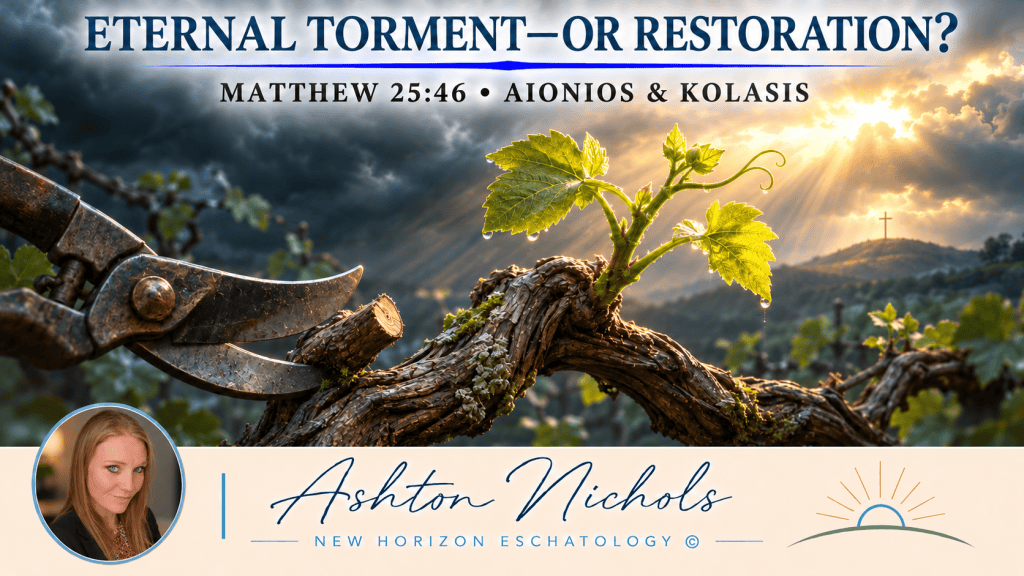
Our next Greek word we’re going to examine in Matthew 25:46 is kolasis, which has been translated as “punishment” in most Bible translations. The Greek word kolasis originally meant “pruning,” “docking,” or “obviating the growth” of trees or other plants. It then evolved to mean “confinement,” “being held in check,” “punishment,” or “chastisement,” chiefly with the connotation of correction. The Greek word kolasis is best understood as beneficial disciplinary correction, similar to how parents discipline their children for misbehavior with the purpose of reform and correction.
I’ve heard many advocates for ECT assert that since aionios is used to describe both “punishment” and “life” in the same passage, it therefore must mean the same thing in both contexts. This is a flawed assertion and does not reflect how languages function. Adjectives reflect back onto the noun they are describing, and the noun also reflects back onto the adjective. “Punishment” and “life” are two distinct nouns.
I would like to show you three translations that focus on the two original Greek words:
– Young’s Literal Translation: “And these shall go away to punishment age-during, but the righteous to life age-during.” (It should be noted “age-during” implies a limited time.)
– David Bentley Hart Translation: “And these will go to the chastening of that age, but the just to the life of that age.” (Personally, I believe this one is the most accurate rendering of the original Greek.)
– Rotherham’s Emphasized Bible: “And these shall go away into age-abiding correction, but the righteous into age-abiding life.”
If Jesus was indeed teaching “eternal/everlasting torment/punishment,” as many Christians today claim based on translations like the King James Version, he would have more likely used Greek words such as aidios, timoria, or adialeiptos to convey that very message. But he did not; he chose to use the words aionios kolasis.
Aionios in Josephus and the Early Creeds
I would also like to point out that the Jewish historian Josephus, writing in Greek to the Jews, uses the same word aionios that Jesus used many times for the duration of corrective punishment. Josephus applies aionios to things that had ended or will end. Here are examples of Josephus’s use of the word aionios:
– The imprisonment of John the tyrant.
– Herod’s reputation.
– The glory acquired by soldiers.
– The fame of an army as a “happy life and aionion glory.”
Josephus used the same words found in scripture to denote limited duration.
Another interesting fact that should be considered is that the Apostles’ Creed, the oldest creedal statement of the Church of Rome, mentions nothing about eternal punishment! It only mentions “to judge the quick and the dead” and “the life everlasting” (aionion life, with no mention of aionion death or punishment). The Nicene Creed is also silent on the doctrine of eternal punishment. If they had believed this doctrine of eternal punishment to be true, they most definitely would have included it in the Creed. It is very telling that both of these ancient sources are silent on eternal punishment.
Punishment as Pruning and Restoration
I would like to briefly return to the Greek word kolasis, specifically “pruning,” as I believe this is the key to understanding what Matthew 25:46 means. Trees are pruned to remove impurities like diseased branches, etc. Pruning is, in essence, medicine for the tree, helping it remain healthy and fruitful. Based on the actual meaning of these words in Matthew 25:46, I believe we should understand it as God imposing disciplinary action for medicinal purposes in order to bring restoration and healing to the lost, not torment.
While writing this, Revelation 22:2 came to mind:
“Down the middle of the great street of the city. On each side of the river stood the tree of life, bearing twelve crops of fruit, yielding its fruit every month. And the leaves of the tree are for the healing of the nations.”
This speaks of restoration! Jesus said in Mark 2:17:
“It is not the healthy who need a doctor, but the sick. I have not come to call the righteous, but sinners.”
Clement of Alexandria on Punishment
In closing, I will leave you with a statement from Clement of Alexandria, a second-century theologian and early church father:
“God’s justice is of itself nothing but goodness, for it rewards the virtuous with blessings, and leads to the improvement of the sinful. There are many evil affections which are to be cured only by suffering. Punishment is, in its operation, like medicine; it dissolves the hard heart, purges away the filth of uncleanness, and reduces the swellings of pride and haughtiness; thus restoring its subject to a sound and healthful state. It is not from hatred, therefore, that the Lord rebukes mankind.”
I hope this post will be a blessing to you and encourages you to dive deeper into scripture, history, and prayer for understanding.
Support the Work
If you found this article valuable and would like to support my writing, your generosity is deeply appreciated.


Leave a Reply