What If 2 Peter 3 Was Never About the End of the World?
Growing up, this was a phrase I heard all my life:
“Ashton, God is going to rapture us out of here, and we’re going to rule and reign with Him for 1,000 years and help Him slay all the wicked people. Then He’s going to destroy the earth with fire and create a new, ‘perfect’ earth for us to live on for all eternity.”
I hate to admit that I used to believe this. They used what seemed to be very convincing scriptures to support these claims, so it was easy to get entangled in this popular misuse of the Bible.
The two main passages people use to push this narrative are 2 Peter 3:6–7 and 2 Peter 3:10. They use Noah’s flood as their primary example, claiming that just as God destroyed the world with water back then, He’s going to wipe it out with fire next time. But let’s take a closer look at what actually happened in Noah’s day.
God did not literally destroy the physical planet with the flood. We are standing on the exact same earth where the flood took place! God spared Noah and his family because they were found righteous in His eyes, and He saved two of every kind of animal to repopulate this physical, literal earth. Noah lived out the rest of his natural life right here on earth. The wicked died a physical death, while the righteous stayed on the earth, reproduced, and kept going. Life on earth went on.
At this point, most Christians usually interject:
“But 2 Peter 3:7 and 3:10 say the heavens and earth will be destroyed by fire! The elements will melt with fervent heat! It’s all going to be wiped out!”
I admit, on the surface, that sounds convincing. I believed that exact interpretation for years until I started digging into the Scriptures for myself and seeking God’s truth in His Word.
Let’s start with a basic dose of common sense:
• Why would God literally destroy the heavens? What sense does that make? The simple answer: it doesn’t.
• Why would God literally destroy the physical world He created? The simple answer: He wouldn’t.
Look at 2 Peter 3:10:
“But the day of the Lord will come like a thief. The heavens will disappear with a roar; the elements will be destroyed by fire, and the earth and everything done in it will be laid bare.”
Let’s break this down. “The day of the Lord will come like a thief.” A thief breaks in at an hour you don’t expect (Matthew 24:44). That is why followers of Christ were told to stay alert and watch for the specific signs Jesus gave them in Matthew 24. A thief doesn’t linger—they get in fast and move quickly.
Now, let me ask you another logical question: if first-century Christians actually believed the literal sky and planet were going to burn up and dissolve, why were they terrified they had missed the Lord’s coming? In 2 Thessalonians 2:1–4, Paul had to write to a church that was panicked because they thought the Day of the Lord had already happened! If they were expecting the physical planet to be destroyed by fire, they obviously would have known it hadn’t happened yet. They wouldn’t have been worried about missing a silent doomsday.
Then we have the famous phrase: “The elements will be destroyed by fire.”
The original Greek word used here for “elements” is stoicheia. It doesn’t mean atoms, molecules, or items on the periodic table. It refers to the basic principles of a religious system!
This word stoicheia appears seven times in the New Testament (Galatians 4:3, 4:9; Colossians 2:8, 2:20; Hebrews 5:12; and 2 Peter 3:10, 3:12). In every single case, the apostles weren’t talking about physical chemistry—they were talking about the ceremonial system, the legalistic framework, and the old way of doing things being burned away.
Taking these verses out of context to claim that God is going to melt the physical earth is a massive error. That idea contradicts God’s historical pattern of judgment, and it directly contradicts dozens of scriptures declaring that the physical earth will endure forever (see Genesis 8:21–22; Psalms 72:17, 78:69, 89:36, 93:1, 96:10, 104:5, 119:90, 148:4–6; Ecclesiastes 1:4; Isaiah 45:17; and Ephesians 3:21).
So, if the literal planet isn’t going to melt, what was Peter actually talking about?
Look at how Jesus describes the judgment on Jerusalem in Matthew 24 and Luke 17. He compares it directly to Noah’s flood and Sodom and Gomorrah (Luke 17:26–30). His point was simple: people were eating, drinking, buying, and selling—doing normal life—right up until judgment hit and wiped out the wicked out of nowhere.
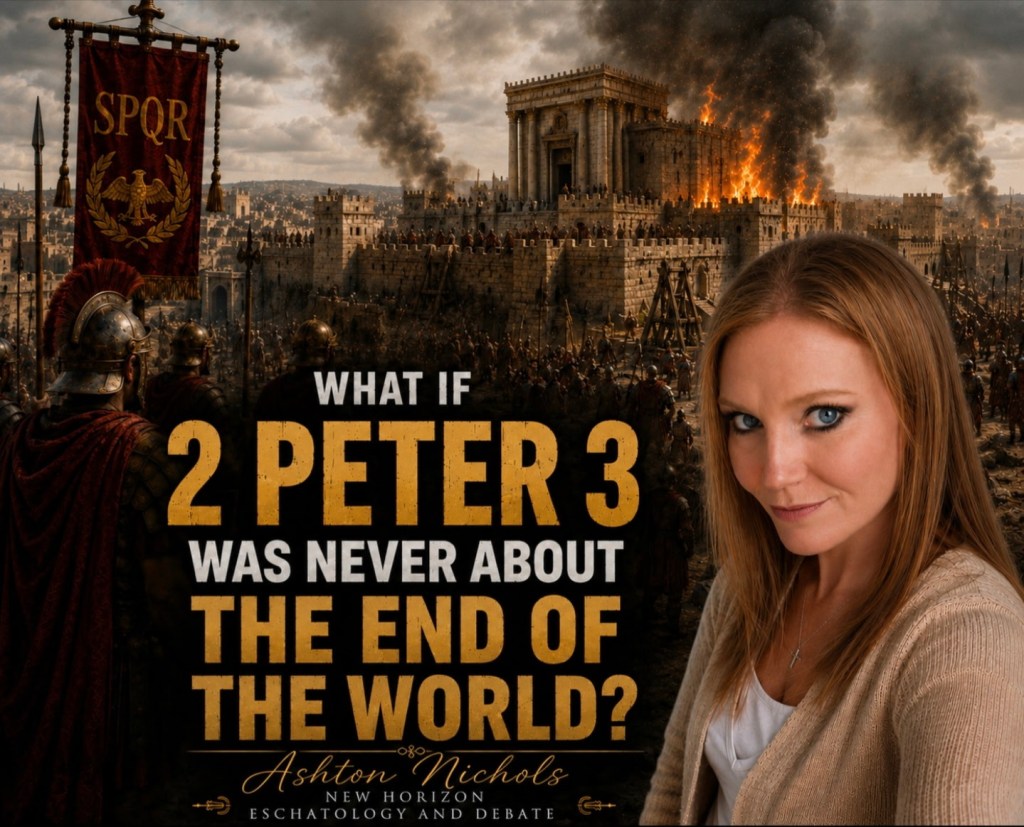
In A.D. 70, that same thing happened to Jerusalem, and it happened with literal fire.
In Jewish culture, “heaven and earth” was a common way to talk about the Temple—the place where heaven and earth met. In August of A.D. 70, Roman soldiers set the Temple on fire. Afterwards, knowing the Temple served as the main treasury and that people hid their valuables inside the structure, the Romans dug up the foundation stones and tore the place apart looking for gold. They left the entire site completely bare—exactly like Jesus said would happen, and exactly as the historian Josephus recorded.
Peter wasn’t writing about a future doomsday movie where the whole universe blows up. He was warning the people of his day about the massive judgment heading for Jerusalem and the Temple in their lifetime.
It’s time to trade fear for clarity. For far too long, these verses have been used to paint a terrifying picture of a future apocalypse rather than recognizing a completed historical judgment.


 Ashton Nichols
Leave a Reply