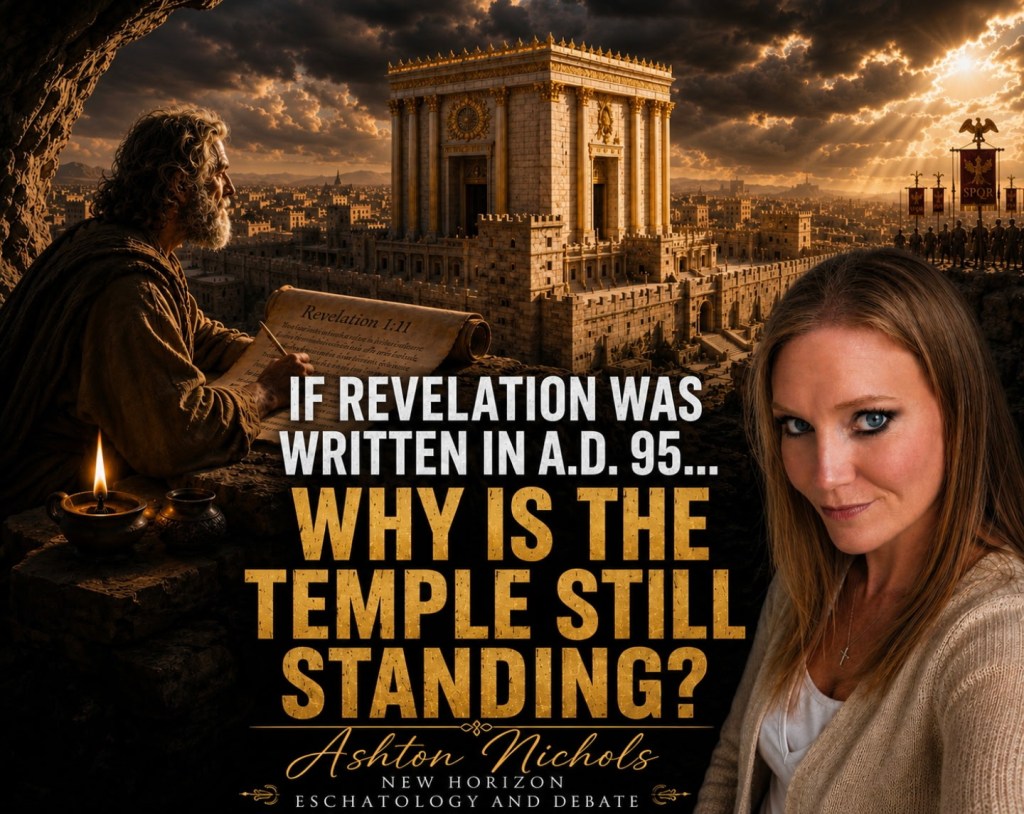
If Revelation Was Written in A.D. 95, Why Is the Temple Still Standing?
Let’s start with a simple thought experiment.
Imagine you were born in New York City in 1978. If I asked you to write an essay about life in the city in 1996, you’d probably mention the 1993 World Trade Center bombing and the political climate of the 90s.
Now, imagine I asked you to write about New York City in 2005. Your account would look completely different. You might briefly mention 1993, but your main focus would undoubtedly be September 11, 2001. The towers came down, nearly 3,000 lives were lost, and the world changed overnight. To write a history of NYC in 2005 and completely skip 9/11 would make zero sense.
We can apply that exact same common-sense logic to the New Testament. If any of the apostolic letters or books were written after A.D. 70, the total destruction of Jerusalem and the Temple would be mentioned. Why? Because it was the central, cornerstone prophecy spoken by Jesus Himself.
The Prophecy of the Temple
In Matthew 24:1–2, Jesus makes a massive prediction:
“As Jesus was leaving the Temple grounds, his disciples pointed out to him the various Temple buildings. But he responded, ‘Do you see all these buildings? I tell you the truth, they will be completely demolished. Not one stone will be left on top of another!’”
Jesus stated point-blank that Jerusalem and its Temple were going to be leveled. Even more importantly, He told the people standing right in front of Him that their generation would see it happen.
Notice how consistent these time statements are throughout the text:
• Matthew 16:28:”And I tell you the truth, some standing here right now will not die before they see the Son of Man coming in his Kingdom.”
• Luke 23:28–31: Jesus warns the “Daughter of Jerusalem” to weep for themselves and their children because of the coming desolation.
Notice the language in Luke 23:30—it mirrors Revelation 6:16–17, where people cry out for the mountains to fall on them to hide them from the “wrath of the Lamb.” Jesus wasn’t warning people living 2,000 years in our future. He was warning the first-century people of His day about a judgment that took place between A.D. 66–70.
The Silence of the New Testament
All through the Bible, whenever a major prophecy comes to pass, the writers make sure to record its fulfillment. In Luke 4:18–21, Jesus reads from Isaiah and boldly tells the crowd, “Today this scripture is fulfilled in your hearing.”
So ask yourself: why does the entire New Testament contain zero mention of the actual fall of Jerusalem or the destruction of the Temple?
That silence speaks volumes. It tells us the New Testament writings were finished before A.D. 70. If they were written after the fact, the apostles would have shouted from the rooftops that Jesus’s massive prophecy had come pass, just like Old Testament writers always noted when the first Temple was destroyed.
John’s Divine Commission
The Book of Revelation itself gives us some of the clearest internal evidence for an early date. Right in chapter one, Jesus gives John specific instructions on how to structure what he’s writing:
Revelation 1:19:”Write the things which thou hast seen, and the things which are, and the things which shall be hereafter.”
Jesus told John to record three distinct things: the past (“things seen”), the present (“the things which are”), and the future.
This instruction is everything when it comes to dating the book. If John was writing in A.D. 95—twenty-five years after Jerusalem was turned to ash—and described the Temple as an active, existing reality, he would have failed his assignment to accurately record “the things which are.”
Look at Revelation 11:1–2:
“Then I was given a reed like a measuring rod. And the angel stood, saying, ‘Rise and measure the temple of God, the altar, and those who worship there. But leave out the court which is outside the temple, and do not measure it, for it has been given to the Gentiles. And they will tread the holy city underfoot for forty-two months.’”
John wasn’t being told to grab a tape measure and calculate literal architectural dimensions for a building project. In biblical symbolism, “measuring” signifies protection, evaluation, and setting apart what belongs to God before judgment falls.
Notice the setting: John is told to measure the inner sanctuary and worshippers, but explicitly instructed to exclude the outer court because it was given over to the Gentiles who would trample the city.
This specific layout—with a distinct Court of the Gentiles surrounding the inner sanctuary—was unique to the Second Temple standing in 1st-century Jerusalem right before the Roman armies breached it.
For John’s symbolic instructions to make any sense as a present reality (“the things which are”), that physical Second Temple had to be standing right then. If John wrote this in A.D. 95 while the Temple site was nothing but Roman rubble and the Gentile trampling had already ended 25 years prior, his description of the present would make no sense.
John wasn’t writing about a fictional structure or a past memory. He was a faithful witness writing prior to A.D. 70 while the Second Temple was still standing and “the time was at hand” for his original readers.
 Ashton Nichols
Leave a Reply